
Who Will Take Care Of My Children If I Die? A Guide For Malaysian Parents
For most parents, the thought of not being there for their children is uncomfortable.
Yet many parents spend considerable time planning for their children’s education, healthcare and financial future without considering one important question:
Who would take care of my children if something happened to me?
While the likelihood of both parents passing away unexpectedly may be low, the consequences can be significant if no arrangements have been made.
Who would raise your children? Where would they live? Would they continue attending the same school? And who would manage the money you leave behind for them?
For families with young children, guardianship is often one of the most important — yet most overlooked — aspects of estate planning.
This guide explains how guardianship works in Malaysia, why choosing the right guardian matters, and how parents can make arrangements to protect their children’s future.
What Is A Guardian?
A guardian is a person who has legal responsibility for a child’s care, welfare or property, depending on the nature of the appointment.
A guardian’s responsibilities generally involve four important areas:
1. Custody
Providing a safe and stable home environment and attending to the child’s day-to-day care.
2. Support
Looking after the child’s daily needs, emotional wellbeing and general upbringing.
3. Education
Making important decisions about the child’s schooling, learning and development.
4. Health
Attending to the child’s healthcare, medical treatment and overall wellbeing.
In simple terms, a guardian may become responsible for many of the important decisions that parents normally make for their children.
Choosing a guardian is therefore not simply about finding someone willing to provide food and shelter.
It is about choosing someone you trust to raise your children with the love, guidance and values you would have wanted.
Who Has The Legal Right To Be A Child’s Guardian In Malaysia?
Many parents assume that the person they nominate in their Will will automatically take over as guardian when they pass away.
However, guardianship is not always that straightforward.
For non-Muslim families in Peninsular Malaysia, the Guardianship of Infants Act 1961 provides an important legal framework.
There are several situations parents should understand.
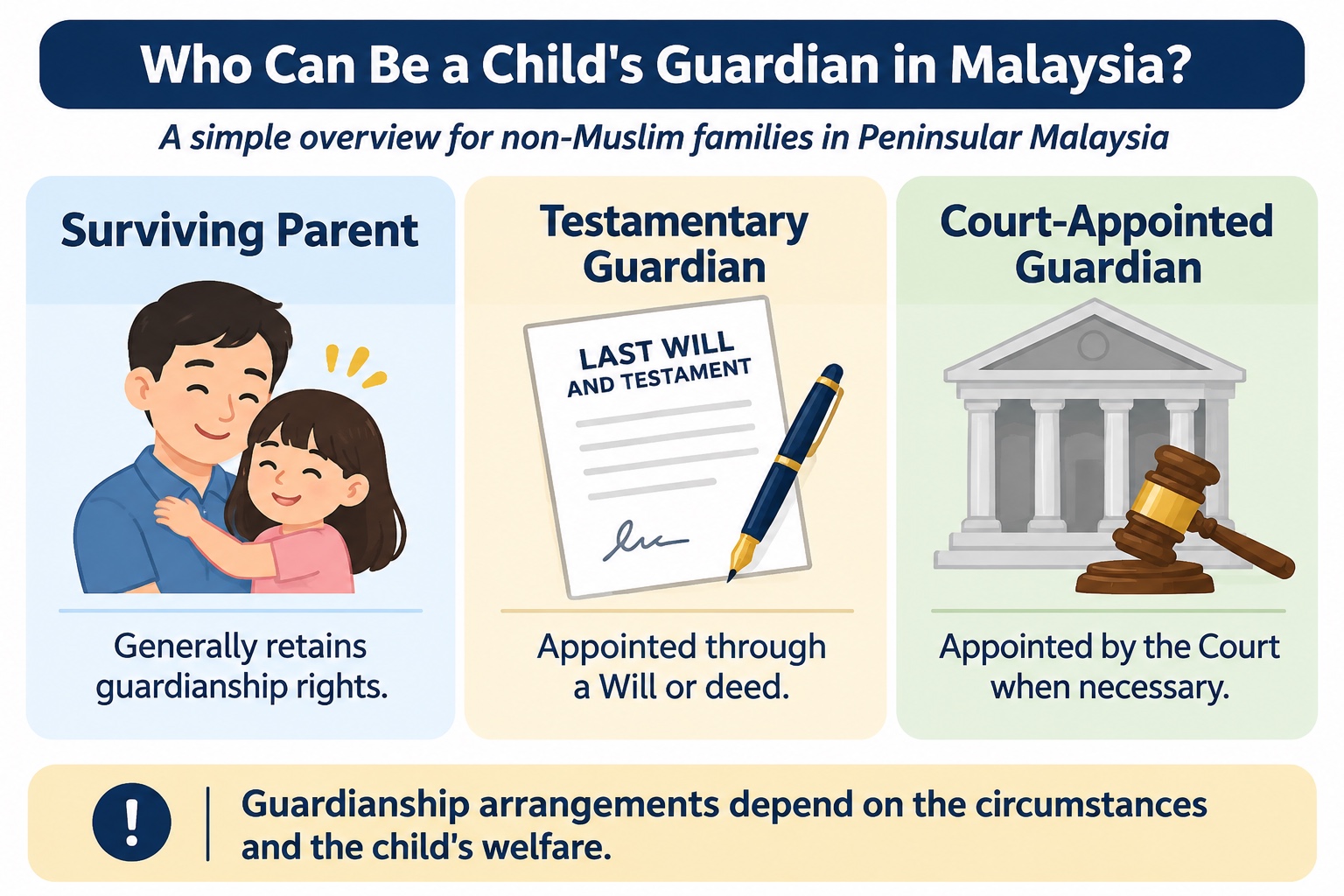
1. The Surviving Parent
If one parent passes away, the surviving parent generally continues to have guardianship rights.
For example, suppose a mother appoints her sister as guardian in her Will.
If the mother passes away while the child’s father is still alive, the appointment does not automatically remove the father’s rights as a parent.
Depending on the circumstances, the appointed guardian may have a role alongside the surviving parent, and disagreements may require the Court’s involvement.
This is an important consideration, particularly for divorced or separated parents who may have concerns about their children’s future care.
2. A Testamentary Guardian
A testamentary guardian is someone appointed by a parent through a Will to act as guardian after the parent’s death.
Under Section 7 of the Guardianship of Infants Act 1961, a parent may appoint a guardian by Will or deed.
For example, a couple with young children may wish to nominate a trusted sibling to care for their children if both parents pass away.
Documenting this appointment helps make their wishes known and provides guidance to family members.
However, the appointment must still be considered alongside the rights of any surviving parent and applicable court orders.
3. A Court-Appointed Guardian
If both parents pass away without appointing a guardian, the Court may need to appoint someone to take responsibility for the children.
The Court may also become involved when disputes arise over guardianship.
Under the Guardianship of Infants Act 1961, the welfare of the child is the primary consideration in guardianship decisions.
This means that being a grandparent, uncle, aunt or other close relative does not automatically guarantee that a person will be appointed guardian.
The important point is that parents should not leave such an important decision entirely to assumptions or family expectations.
Why Does Guardianship Planning Matter?
Many parents assume:
“My family already knows who should take care of my children.”
Unfortunately, things are not always that straightforward.
Families may have different expectations, opinions or interpretations of what the parents would have wanted.
For example, the maternal grandparents may believe the children should live with them, while the paternal grandparents may have a different opinion.
Both sides may genuinely love the children and want what is best for them.
But what happens if they cannot agree?
Without clear arrangements, uncertainty can arise during an already difficult and emotional period.
For young children who have just lost their parents, the last thing they need is further uncertainty about where they will live and who will care for them.
Are Verbal Wishes Enough To Appoint A Guardian?
Many parents believe that telling their family members about their preferred guardian is sufficient.
For example:
“If anything happens to us, please help take care of our children.”
While such conversations are valuable, verbal wishes alone do not constitute a formal appointment of a testamentary guardian under the Guardianship of Infants Act 1961.
A properly drafted Will allows parents to formally nominate a guardian and document their wishes.
However, appointing a guardian in a Will does not guarantee that disputes will never arise or that the appointment will override the rights of a surviving parent.
The child’s welfare remains an important legal consideration.
Nevertheless, documenting your wishes can provide valuable clarity and guidance for the people left behind.
If you would like to understand how a Will works, read our guide:
A Real-Life Example Of Why Guardianship Matters
In July 2021, Oriental Daily reported a heartbreaking case involving a 12-year-old Malaysian girl.
The girl came from a single-parent family and had been living with her mother and grandmother.
Tragically, both her mother and grandmother passed away within a week after contracting COVID-19.
The young girl, who was also receiving treatment in hospital, suddenly lost the two people she depended on most.
According to the report, a lawyer and concerned individuals had been trying to assist the family.
When the grandmother’s condition deteriorated, arrangements were urgently made to prepare a Will to address estate matters and protect the girl’s interests.
Unfortunately, the grandmother passed away before the document could be signed.
The girl’s guardianship situation then became a serious concern, requiring assistance from the relevant authorities.
Source: Oriental Daily, 30 July 2021 —12-Year-Old Girl Faces Guardianship Uncertainty After Losing Mother And Grandmother.
This case highlights an important reality.
Sometimes, even when family members and professionals are willing to help, unexpected circumstances can leave very little time to make the necessary arrangements.
It also reminds us that guardianship planning is not only about who will inherit our assets.
It is about who will be there to care for our children when we are no longer around.
What Happens If Both Parents Pass Away Without A Will?
If both parents pass away without valid Wills, their family members may face several challenges at the same time.
Apart from dealing with grief and making arrangements for the children, they may also need to address:
- Guardianship and living arrangements
- Estate administration
- Access to financial resources
- Property and asset management
- Ongoing education and living expenses
If no guardian has been formally appointed, legal steps may be necessary to establish who should take responsibility for the children.
At the same time, the parents’ assets may need to go through the estate administration process before they can be distributed.
For young children who cannot independently manage substantial assets, additional arrangements may be required to safeguard their inheritance.
This is why guardianship planning and financial planning should be considered together.
Related Reading: What Happens If You Die Without A Will In Malaysia?
How Do You Choose The Right Guardian For Your Children?
There is no single perfect guardian.
Every family is different, and the person who is suitable for one child may not necessarily be suitable for another.
However, there are four important factors parents should consider before making this decision.
1. Relationship With Your Children
Does the person already have a close relationship with your children?
Are your children comfortable around them?
Do they understand your children’s personalities, emotional needs and upbringing?
A close relationship may help children adjust during a difficult transition.
Parents should also consider whether the potential guardian shares similar family values and parenting principles.
After all, you are not simply choosing someone to provide a roof over your children’s heads.
You are choosing someone who may play an important role in shaping their character, values and future.
2. Location And Living Arrangements
Where does the potential guardian live?
Would your children need to move to another city or country?
Would they need to change schools, leave their friends or adjust to a completely different environment?
For children who have already experienced the loss of their parents, maintaining some familiarity and stability may be especially important.
Parents should consider how the guardian’s location and living arrangements might affect their children’s daily lives.
3. Financial Capability
Raising children requires financial resources.
Parents should consider whether the potential guardian has the financial stability to provide a suitable living environment.
However, being wealthy does not automatically make someone a better guardian.
A loving and responsible person with modest financial means may still be an excellent choice.
This is where estate planning becomes important.
Parents can make separate arrangements to provide financial resources for their children’s upbringing, education, healthcare and living expenses.
For example, a properly structured trust may allow funds to be managed and released for the children’s needs, reducing the financial burden on the guardian.
4. Time And Availability
Does the person have enough time to care for your children?
For example, elderly grandparents may love their grandchildren deeply but may face limitations due to age or health.
A younger sibling may be financially capable but have demanding work commitments or young children of their own.
Parents should consider whether the potential guardian can realistically take on the responsibilities involved.
Most importantly, have you discussed the responsibility with the person you intend to appoint?
Never assume someone will automatically be willing or able to become a guardian simply because they are a close relative.
Should The Guardian And Trustee Be The Same Person?
Not necessarily.
This is an important distinction that many parents overlook.
A guardian is responsible for the child’s care and upbringing.
A trustee is responsible for managing assets held under a trust for the beneficiaries.
Although one person may perform both roles, parents can also choose to separate these responsibilities.
For example:
Guardian: A trusted family member who provides day-to-day care and emotional support.
Trustee: A professional trustee company appointed to manage the children’s inheritance according to the Will or trust arrangement.
This arrangement can be particularly useful where the children are young or the inheritance involves substantial assets.
A trustee company’s responsibilities may include:
- Safeguarding the children’s inheritance
- Managing trust assets and investments
- Releasing funds for education, healthcare and maintenance according to the trust terms
- Distributing the remaining inheritance according to the parents’ instructions
Meanwhile, the guardian can focus on raising the children without having to personally manage substantial financial assets.
Separating these roles may provide greater accountability and help reduce potential misunderstandings involving money.
It may also provide greater continuity in the management of the inheritance, particularly where the children will remain beneficiaries for many years.
However, appointing a trustee company is not compulsory for every family. The appropriate arrangement depends on the family’s circumstances, available assets and planning objectives.
Related Reading: How To Choose The Right Executor Or Trustee For Your Will
What About The Children’s Inheritance?
Appointing a guardian is only one part of protecting your children’s future.
Parents should also consider what happens to their assets if they pass away while their children are still minors.
For example:
- Who will manage the inheritance?
- How will school fees and daily expenses be paid?
- Can funds be used for medical treatment or emergencies?
- At what age should the children receive their inheritance?
- What happens if the guardian is unable to continue caring for them?
These questions become especially important when children are too young to manage substantial financial assets independently.
A Will containing an appropriately structured testamentary trust may help parents provide instructions on how their children’s inheritance should be managed and used.
For example, parents may wish for funds to be made available for education, healthcare and living expenses, with the remaining inheritance distributed when their children reach specified ages.
The key is to ensure that the children’s financial needs are considered alongside their caregiving arrangements.
Can Family Disputes Arise Over Guardianship?
Unfortunately, disagreements among relatives regarding children’s care can happen.
Most disputes do not necessarily arise because family members have bad intentions.
Different relatives may genuinely believe they are acting in the child’s best interests.
However, disagreements can lead to:
- Delays in making arrangements
- Emotional tension
- Strained family relationships
- Additional legal expenses
- Uncertainty for the children
Financial matters may also become a source of disagreement, especially where substantial assets are involved.
Documenting your wishes, discussing them with the intended guardian and considering an independent trustee may help reduce some of these risks.
Of course, a Will cannot guarantee that family disputes will never happen.
But clear instructions can provide valuable guidance and reduce avoidable misunderstandings.
Related Reading: How A Will Helps Prevent Family Disputes
Why Every Parent Should Consider Having A Will
For parents with young children, a Will is about much more than deciding who receives their assets.
It can help parents:
- Formally nominate guardians for their children
- Appoint executors and trustees
- Provide instructions for managing their children’s inheritance
- Set out their wishes clearly
- Reduce uncertainty for family members
- Make financial arrangements to support their children’s future
A Will does not eliminate every legal or practical difficulty.
However, having appropriate arrangements in place can make an already difficult situation more manageable for the people left behind.
If you are a parent and are unsure where to begin, our Estate Planning Checklist For Parents In Malaysia can help you identify the important areas to review.
Protecting The People You Love
Most parents hope their guardianship arrangements will never be needed.
And fortunately, for most families, they never will be.
However, estate planning is not about preparing only for what is likely to happen.
It is also about preparing for what could happen.
Choosing a guardian is not simply about naming someone in a document.
It is about thinking carefully about who could provide the love, stability, guidance and support your children would need if you were no longer around.
At the same time, making appropriate financial arrangements can help ensure that the person caring for your children has access to the support needed to raise them.
The right arrangements will differ from family to family.
But taking the time to consider these questions today can provide greater clarity and peace of mind for the people who matter most.
Related Articles
- What Is A Will In Malaysia?
- What Happens If You Die Without A Will In Malaysia?
- How A Will Helps Prevent Family Disputes
- Estate Planning Checklist For Parents In Malaysia
- How To Choose The Right Executor Or Trustee For Your Will
Would You Like To Review Your Family’s Estate Planning Arrangements?
If you have young children and would like to understand how a Will, guardianship nomination and trust arrangements may work together, you may arrange a discussion with us.
We can help you review your family’s circumstances, identify potential gaps and explore suitable estate planning arrangements to protect your loved ones.
Disclaimer: This article is for general educational and informational purposes only and does not constitute legal, financial or estate planning advice. The information provided may vary depending on individual circumstances and applicable Malaysian laws. Readers are encouraged to seek appropriate professional advice before making any decisions.