
What Happens to Your Housing Loan When You Die in Malaysia?
What happens to your housing loan if you pass away before finishing your repayments?
Will the bank cancel the outstanding loan? Will your MRTA or MLTA settle everything? Or will your spouse and family have to continue paying?
Many Malaysian property owners assume that their housing loan will automatically be settled upon death, especially if they have purchased mortgage insurance. However, this is not always the case.
Over the years, while helping clients with financial and estate planning, I have noticed that many property owners are unsure whether their existing mortgage protection is sufficient. Some may not even realise that there could be a shortfall between their outstanding housing loan and the insurance coverage available.
The good news is that potential financial shortfalls can be identified and planned for before they become a financial burden on your loved ones.
Whether you own a house, condominium or investment property, understanding what happens to your housing loan after death is an important part of protecting your family’s financial future.
In this article, we will explain what happens to a housing loan when the borrower dies in Malaysia, how MRTA and MLTA work, what happens to jointly owned properties, and how proper financial and estate planning can help reduce the risk of your family having to sell a property unexpectedly.
Does the bank automatically write off a housing loan when the borrower dies?
No. A housing loan is a debt owed to the bank, and the borrower’s death does not automatically cancel that debt.
If the housing loan is protected by mortgage insurance or takaful, the insurer or takaful operator may pay some or all of the outstanding balance, subject to the coverage and policy terms.
If there is no coverage, or if the payout is insufficient, the remaining debt must still be addressed.
Depending on the circumstances, this may involve:
- The deceased’s estate settling the outstanding loan
- A surviving joint borrower continuing repayments
- Using insurance proceeds or other available funds
- Selling the property to repay the bank
- Exploring refinancing or restructuring options, subject to the bank’s approval
The bank generally retains its security over the charged property until the relevant obligations are satisfied.
This means that owning or inheriting a property and settling its housing loan are two separate matters.
A beneficiary may be entitled to inherit the property, but the outstanding loan and the bank’s charge must still be dealt with.
What Happens to MRTA When a Housing Loan Borrower Dies?
Many Malaysian property buyers purchase Mortgage Reducing Term Assurance (MRTA) when taking up a housing loan.
MRTA is a type of mortgage protection insurance designed to help settle the outstanding housing loan if the insured borrower dies during the coverage period, subject to the policy terms.
The important word is “Reducing.”
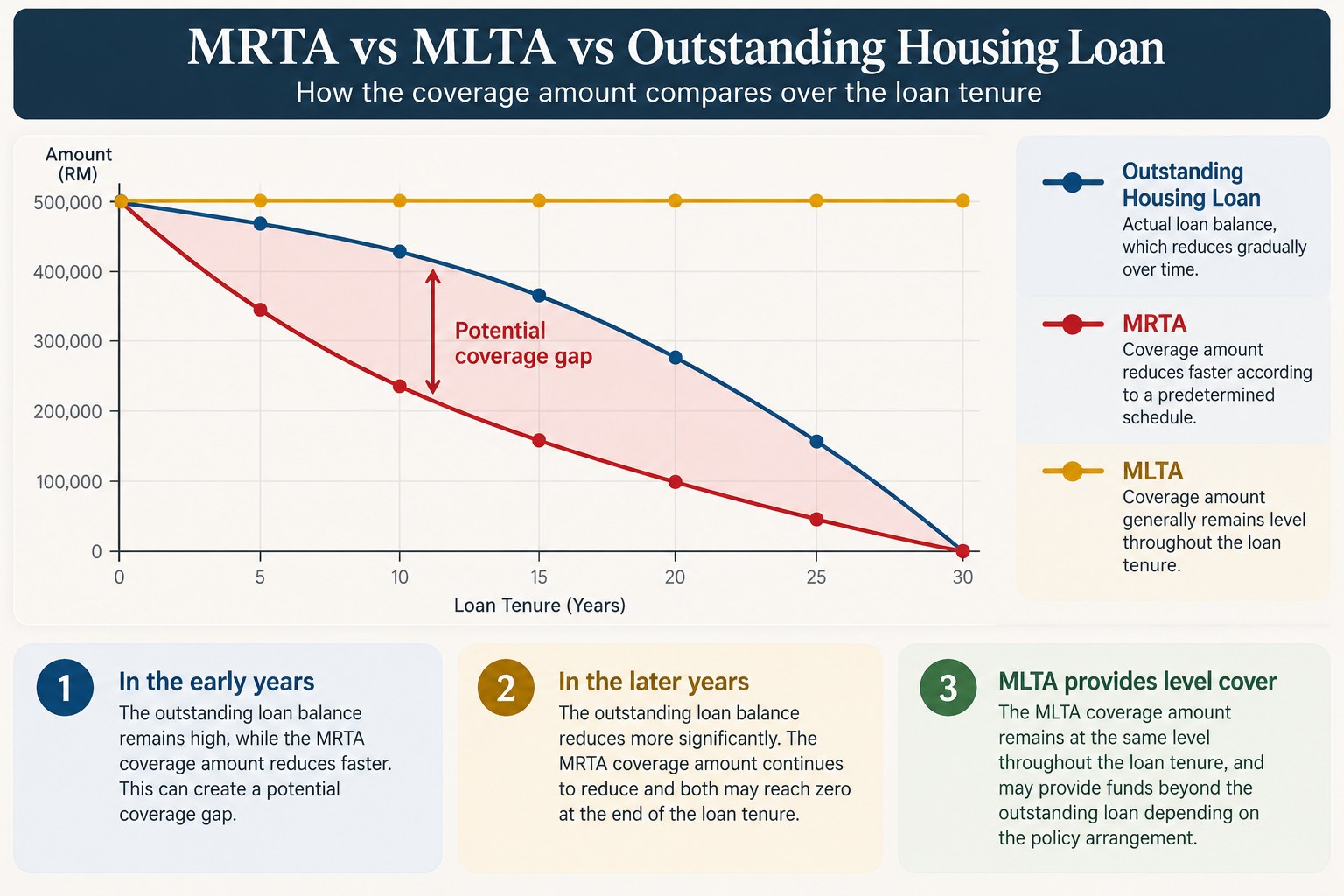
Under MRTA, the insured amount generally decreases over time according to a predetermined schedule. This is intended to follow the gradual reduction in the housing loan balance as repayments are made.
However, property owners should not assume that the MRTA payout will always match the actual outstanding loan.
Does MRTA Guarantee Full Settlement of the Housing Loan?
Not necessarily.
Although MRTA is designed to reduce alongside the loan balance, a shortfall may occur if:
- The MRTA covers only part of the original housing loan.
- The insurance coverage period is shorter than the loan tenure.
- The property owner refinances or increases the loan without reviewing the coverage.
- Changes in interest rates or repayment arrangements cause the actual loan balance to differ from the original schedule.
- The claim is affected by exclusions or other policy limitations.
A reducing coverage amount does not automatically mean there will be a shortfall. The important question is whether the available insurance payout will be sufficient to settle the actual outstanding loan when a valid claim arises.
A Common Situation Many Property Owners Face
Imagine a property owner has an outstanding housing loan of RM450,000.
Upon the owner’s death, the available MRTA payout is RM380,000.
| Description | Amount |
|---|---|
| Outstanding housing loan | RM450,000 |
| MRTA payout | RM380,000 |
| Remaining shortfall | RM70,000 |
The RM70,000 shortfall does not automatically disappear.
The surviving family members and estate representative would need to consider how the remaining amount should be settled.
This is a hypothetical example to illustrate a possible coverage gap. It does not mean MRTA normally results in a shortfall.
The example shows why property owners should review the actual coverage amount, policy duration and outstanding loan balance instead of assuming that having MRTA means their property is fully protected.
What Is MLTA, and How Is It Different From MRTA?
Mortgage Level Term Assurance (MLTA) is another form of mortgage protection commonly considered by Malaysian property owners.
Unlike MRTA, which generally reduces over time, MLTA typically maintains a level sum assured throughout the coverage period.
This means that, depending on the policy structure, the amount of protection may remain unchanged even as the outstanding housing loan decreases.
MRTA vs MLTA: What Should Property Owners Know?
| Feature | MRTA | MLTA |
|---|---|---|
| Coverage amount | Generally reduces over time | Generally remains level |
| Main purpose | Help settle the outstanding housing loan | Provide level protection that may be used for mortgage settlement |
| Premium structure | Commonly a single premium | May involve single or ongoing premiums, depending on the product |
| Potential excess payout | Depends on policy terms and the claim arrangement | May provide funds beyond the outstanding loan, depending on the arrangement |
| Flexibility | Usually closely linked to the original loan | Depends on policy structure and assignment arrangements |
For example, suppose a property owner has MLTA coverage of RM500,000 and the outstanding housing loan has reduced to RM300,000.
If a valid claim results in a RM500,000 payout, RM300,000 may be used to settle the loan, leaving RM200,000 potentially available for other purposes, depending on the policy’s assignment, nomination and beneficiary arrangements.
That additional amount could provide valuable support for the surviving family.
However, MLTA is not automatically better than MRTA.
The appropriate choice depends on affordability, existing life insurance protection, the housing loan arrangement and the family’s overall financial needs.
Property owners using Islamic home financing may also come across mortgage takaful products such as Mortgage Reducing Term Takaful (MRTT) and Mortgage Level Term Takaful (MLTT).
The important point is not simply which product was purchased, but whether the overall protection remains adequate.
What Happens If There Is No MRTA, MLTA or Mortgage Protection?
If a property owner dies without sufficient mortgage protection, the outstanding housing loan remains a financial obligation.
This can become particularly challenging if the deceased was the family’s primary income earner.
For example, a surviving spouse may suddenly need to manage household expenses, children’s education costs and monthly housing loan repayments with a reduced family income.
Depending on the circumstances, the family may need to:
- Continue servicing the outstanding loan
- Use available savings or estate assets
- Discuss refinancing or restructuring with the bank
- Sell the property to settle the debt
If repayments stop and the loan falls into default, the bank may eventually take enforcement action against the property, including a possible auction.
Are Family Members Personally Responsible for the Deceased’s Housing Loan?
Not necessarily.
Being a spouse, child or beneficiary does not automatically make someone personally responsible for the deceased’s housing loan.
Generally, the deceased’s debts are dealt with through the estate.
However, a surviving person may have personal repayment obligations if they are also a joint borrower or guarantor under the financing documents.
Even if a beneficiary is not personally liable for the loan, the property may still be subject to the bank’s charge.
In other words, the beneficiary may not owe the debt personally, but the property itself may remain at risk if the secured debt is not addressed.
What Happens If a Property Is Jointly Owned and One Owner Dies?
Many married couples purchase their family homes under both names.
A common misunderstanding is that when one spouse passes away, the other automatically inherits the entire property and only needs to repay half the loan.
However, property ownership and housing loan obligations are two different matters.
Under ordinary registered co-ownership arrangements in Peninsular Malaysia, property owned by two or more people is generally held as tenancy in common.
Each co-owner has a separate undivided share in the property.
For example, if a husband and wife own a house as tenants in common in equal shares, each owns 50%.
When the husband passes away, his 50% share generally forms part of his estate. It does not automatically transfer to his wife merely because she is the surviving co-owner.
The inheritance and transfer of that share require the appropriate estate administration arrangements.
Learn more in our complete guide: What Happens to a House When the Owner Dies in Malaysia?
If a Property Is Owned 50:50, Does Only 50% of the Housing Loan Need to Be Settled?
No.
The ownership percentage does not automatically determine how much is owed to the bank.
For example:
| Description | Amount |
|---|---|
| Property value | RM800,000 |
| Husband’s ownership | 50% |
| Wife’s ownership | 50% |
| Outstanding housing loan | RM400,000 |
If the husband passes away, the loan does not automatically reduce to RM200,000 simply because he owned half the property.
If the husband and wife are joint borrowers, the financing agreement may make them jointly and severally responsible for the debt.
This generally means the bank may look to the surviving borrower for repayment of the full outstanding amount, subject to the financing documents and any available insurance payout.
Even if a person is a registered property owner but not a named borrower, their interest may still be affected if the property is charged to the bank.
For this reason, property owners should review three important documents:
- The property title or ownership records
- The housing loan agreement
- The mortgage insurance or takaful policy
The names appearing in these documents may not be the same, and each document serves a different purpose.
Is Your Family Financially Prepared to Keep the Property?
Having sufficient mortgage protection is important, but it is only one part of the picture.
Even if the outstanding housing loan is fully settled upon death, would your family have sufficient financial resources to maintain the property and meet their ongoing living expenses?
A comprehensive estate planning review can help identify potential financial gaps by considering:
- Outstanding liabilities: Housing loans and other debts that may need to be settled.
- Existing financial resources: Savings, investments and insurance coverage already available.
- Estate liquidity: Whether sufficient accessible funds would be available to meet debts and expenses without selling important assets.
- Family’s future needs: Ongoing living expenses, education costs and other financial commitments.
Depending on the circumstances, addressing these gaps may involve better utilisation of existing assets, reviewing debt arrangements, improving estate liquidity or considering additional financial protection where appropriate.
The solution does not necessarily involve purchasing more insurance.
As a Licensed Financial Planner and Rockwills Estate Planner, I help clients look beyond the preparation of a Will to identify potential financial and estate planning gaps that could affect their intended beneficiaries.
The objective is to help ensure that their estate plan is not only legally structured, but also financially practical.
Can Estate Planning Help Prevent a Forced Property Sale?
One aspect of estate planning that is often overlooked is estate liquidity — having sufficient accessible financial resources to meet obligations when needed.
A person may own several valuable properties but have relatively little cash available.
For example, imagine someone owns two properties worth a combined RM1.5 million but has outstanding housing loans and limited savings.
On paper, that person appears to have substantial wealth.
However, if the estate does not have enough liquidity to settle debts and administration expenses, the family may need to sell one of the properties.
A sale under financial pressure may not achieve the best possible outcome.
This is why estate planning should consider not only what assets a person owns, but also the liabilities attached to those assets and the financial resources available to the estate.
How Can Property Owners Reduce the Risk of Estate Shrinkage?
Estate shrinkage refers to a reduction in the value ultimately available to beneficiaries because of liabilities, expenses or other financial pressures.
Although some costs cannot be avoided, thoughtful planning may help reduce unnecessary financial losses.
Depending on the circumstances, suitable arrangements may include:
- Reviewing mortgage protection coverage
- Maintaining appropriate life insurance or takaful protection
- Making provisions for estate liquidity
- Reviewing outstanding debts and property ownership arrangements
- Preparing a valid Will
- Considering suitable trust arrangements where necessary
The objective is not simply to accumulate properties, but to preserve more of their value for the people you intend to benefit.
Why Is Having a Will Important for Property Owners?
A Will cannot eliminate your housing loan or remove the bank’s legal rights over a charged property.
However, it can help clarify how you want your properties and other assets to be distributed.
A properly drafted Will can help you:
- Specify who should inherit particular properties
- Appoint an executor to administer your estate
- Provide instructions for the distribution of your assets
- Make appropriate arrangements for minor beneficiaries
- Reduce uncertainty and potential family disputes
For example, you may wish for your spouse to inherit the family home while your investment property eventually passes to your children.
However, such arrangements should also be reviewed alongside outstanding loans and available financial resources.
Otherwise, the intended distribution may be difficult to carry out without selling assets or finding additional funds.
A Will provides direction, but the estate must also have sufficient resources to carry out that direction.
Related Reading: What Is A Will In Malaysia?
When Should Property Owners Review Their Mortgage Protection and Estate Plan?
Property ownership, loan balances and family circumstances can change over time.
You should consider reviewing your arrangements after:
- Purchasing a property
- Refinancing or increasing a housing loan
- Getting married
- Having children
- Purchasing additional properties
- Making significant changes to your insurance coverage
- Experiencing major changes in income, debts or family circumstances
A mortgage protection arrangement that was suitable when you first purchased your property may no longer be sufficient several years later.
A periodic review can help identify potential gaps before they become financial problems for your family.
A Practical Checklist for Malaysian Property Owners
Whether you own one home or several investment properties, ask yourself:
- Do I know the outstanding balance of each housing loan?
- Do I have MRTA, MLTA, MRTT or other mortgage protection?
- Does the coverage still match the outstanding loan and remaining tenure?
- Have I refinanced or increased my housing loan?
- If I have a joint borrower, whose life is insured and for how much?
- Is my property solely owned or a joint name?
- Would my family have sufficient funds to continue living in the property?
- Do I have enough financial protection beyond the housing loan?
- Would my estate have sufficient liquidity to settle debts without selling important assets?
- Does my Will reflect my current property ownership and inheritance intentions?
You do not need to wait until you are ready to write a Will to review these matters.
Understanding your property ownership, loan obligations and financial protection is already an important part of responsible financial planning.
Frequently Asked Questions About Housing Loans After Death in Malaysia
1. Will the bank automatically take my house if I die?
No. The bank does not automatically take ownership of your house simply because you pass away.
However, the outstanding loan remains payable. If the debt is not serviced or settled, the bank may eventually enforce its security over the property.
2. Is MRTA compulsory when buying a house in Malaysia?
Not necessarily.
The requirement depends on the bank, financing package and applicable loan conditions.
Property buyers should check their loan offer rather than assume MRTA is always compulsory or always optional.
3. If I have MRTA, will my family receive a fully paid-off house?
Possibly, if the insurance payout is sufficient to settle the outstanding housing loan.
However, this depends on the coverage amount, remaining loan balance, policy duration and claim terms.
Settling the loan also does not automatically transfer ownership of the property to your family.
4. If my spouse and I jointly own a house, must the surviving spouse repay the entire loan?
If the surviving spouse is also a joint borrower, the financing agreement may make them responsible for the full outstanding loan, subject to any available insurance payout.
A 50:50 ownership arrangement does not automatically mean each borrower owes only half the debt.
5. Can family members continue paying the deceased’s housing loan?
In some cases, repayments may continue while the estate is being administered.
However, any refinancing, change in borrowers or transfer of financing arrangements may require the bank’s approval.
Continuing repayments does not automatically make someone the legal owner.
6. Does a Will settle the outstanding housing loan?
No.
A Will helps clarify inheritance intentions and appoint an executor, but it does not eliminate debts.
The outstanding loan and the bank’s security must still be addressed.
7. Can insurance planning help prevent my family from selling the house?
Potentially.
Suitable financial protection and estate liquidity arrangements may provide funds to settle debts or support the surviving family.
However, the amount required depends on the family’s actual liabilities, available assets and future financial needs.
Protecting Your Property Goes Beyond Settling the Loan
A housing loan does not automatically disappear when the borrower passes away.
Whether the outstanding debt can be settled depends on the financing arrangements, mortgage insurance coverage and the financial resources available.
For many Malaysian families, the family home represents years of hard work, financial commitment and cherished memories.
For others, investment properties form an important part of their long-term wealth-building strategy.
Whichever situation applies to you, property planning should not stop at purchasing the property and making monthly repayments.
Review your outstanding loans. Check your mortgage protection. Understand your ownership arrangements. Consider whether your family would have enough financial resources to retain the property and continue meeting their living expenses.
As a Licensed Financial Planner and Rockwills Estate Planner, I help clients consider how their financial protection and estate planning arrangements work together, so potential gaps can be identified and suitable solutions explored.
Good estate planning is not only about deciding who inherits your assets. It is also about protecting their value, managing financial obligations and helping your loved ones remain financially secure.
Related Articles
- What Happens to a House When the Owner Dies in Malaysia?
- What Happens If You Die Without A Will In Malaysia?
- What Is A Will In Malaysia?
- Estate Planning Checklist For Parents In Malaysia
- Who Will Take Care Of My Children If I Die?
- How To Choose The Right Executor Or Trustee For Your Will
- How A Will Helps Prevent Family Disputes
Disclaimer: This article is for general educational and informational purposes only and does not constitute legal, financial or estate planning advice. The information provided may vary depending on individual circumstances and applicable Malaysian laws. Readers are encouraged to seek appropriate professional advice before making any decisions.